Autism Physiotherapy Treatment: Assessment and Management
If your child has recently been diagnosed with Autism Spectrum Disorder (ASD), you are probably trying to understand which therapies can genuinely make a difference to their day-to-day life. Physiotherapy is one of the most evidence-backed and underutilised supports available for children on the spectrum. Yet many parents in India are still unaware of how a trained physiotherapist can help, what the assessment process looks like, and what to realistically expect from treatment.
This guide breaks it all down clearly, from the science behind why physiotherapy works for autism, to the specific techniques used, to how you can bring this care right to your doorstep in Bangalore.
What Is Autism Spectrum Disorder and Why Does It Affect Movement?
Autism Spectrum Disorder is a neurodevelopmental condition characterised by differences in social communication, sensory processing, and behaviour patterns. According to the DSM-5 (Diagnostic and Statistical Manual of Mental Disorders, Fifth Edition), ASD is defined by persistent deficits in social interaction alongside restricted and repetitive behaviours.
What many people do not realise is that ASD also affects the body, not just communication or behaviour. Research consistently shows that a significant proportion of autistic children experience motor difficulties. These can range from low muscle tone and poor postural control to challenges with coordination, balance, and motor planning.
A 2022 study published in Autism Research found that multidimensional motor performance in children with autism often predicts social communication delay, language delay, and repetitive behaviour severity. In simpler terms, when a child’s motor development is supported early and effectively, it can have a ripple effect on their overall development.
This is exactly where autism physiotherapy steps in.
Why Physiotherapy Matters for Children with ASD
Physiotherapy for autism is not about “fixing” a child or curing the condition. Rather, it is about supporting the child’s physical development so that they can participate more fully in everyday life, whether that means joining playground games, sitting comfortably in a classroom, or improving their ability to self-care.
Children with ASD commonly face the following physical challenges that a physiotherapist is trained to address:
Motor development delays: Gross motor skills like walking, running, jumping, hopping, and catching a ball are frequently delayed in children with ASD. Fine motor tasks such as writing, buttoning a shirt, or using cutlery can also be affected.
Low muscle tone (hypotonia): Many autistic children appear floppy or have less resistance in their muscles, making sustained physical effort more tiring. This can lead to poor sitting posture, avoidance of physical play, and frequent falls.
Postural deviations: Lordotic posture while standing, kyphotic posture while sitting, and protracted shoulders are commonly observed. Left unaddressed, these can contribute to discomfort and secondary musculoskeletal issues as the child grows.
Poor balance and coordination: Children with ASD often have difficulty executing movements in sequential patterns, which affects sports participation, school-based physical education, and independence in daily activities.
Sensory processing differences: Many autistic individuals are either over-sensitive or under-responsive to sensory input. This directly influences how they move through the world and can cause anxiety or behavioural responses in busy or stimulating environments.
Hypermobility of joints: Flat feet, hyperextension of elbows and knees, and generalised joint laxity are frequently seen, requiring targeted strengthening work to provide joint stability.
Our Pediatric Physiotherapy service is specifically designed to address these challenges in a child-friendly, family-centred way.
Autism Physiotherapy Assessment: What It Involves
Before any treatment begins, a thorough assessment is essential. A good physiotherapy assessment for autism looks at the whole child, not just a list of impairments.
Initial Case History and Parent Interview
The assessment begins with a detailed discussion with parents or caregivers. The physiotherapist will want to understand the child’s developmental history, current daily routine, school performance, previous therapy, sleep patterns, and specific concerns the family has noticed. This contextual information is just as important as any clinical test.
Neuromuscular and Musculoskeletal Evaluation
The physiotherapist will then evaluate the child’s neuromuscular and musculoskeletal systems. This includes assessing muscle tone across different muscle groups, checking for muscle tightness (particularly in neck flexors, pectoral muscles, and hip flexors), and identifying areas of weakness such as scapular winging or knee instability.
Standardised Assessment Tools
Several validated tools are used in clinical practice to objectively measure the child’s physical status:
- Bruininks-Oseretsky Test of Motor Proficiency (BOTMP): Measures fine and gross motor skills across eight subtests. It provides a reliable picture of where the child stands relative to their age group.
- Modified Berg Balance Scale: Evaluates functional balance through 14 tasks, adapted for use with children.
- Pediatric Evaluation of Disability Inventory (PEDI): Looks at functional capabilities in self-care, mobility, and social function.
- Sensory Profile: Helps map out sensory processing patterns so the treatment plan can be appropriately calibrated.
It is worth noting that no single assessment tool has been specifically validated exclusively for children with ASD. Experienced physiotherapists therefore use a combination of tools alongside careful clinical observation. Multiple sessions may be needed to build an accurate picture, especially if the child’s cooperation is variable.
Gait and Postural Analysis
The physiotherapist will observe how the child walks, runs, and transitions between postures. Gait abnormalities, toe-walking, and unusual arm positioning during movement are commonly noted and guide the direction of intervention.
Autism Physiotherapy Treatment: Techniques That Work
Once the assessment is complete, a personalised treatment plan is developed in collaboration with the parents. Below are the main physiotherapy approaches used for children with autism.
1. Gross Motor Skills Training
This is often the backbone of the treatment programme. Exercises are designed around age-appropriate physical activities such as jumping, skipping, hopping, kicking a ball, climbing, and throwing. These activities are not random. They are carefully selected to target specific motor milestones the child has not yet reached or needs to consolidate.
Repetition and consistency are key. Research from Advanced Autism Services highlights that both during therapy sessions and at home, repetitive and structured practice produces the best and most sustained outcomes.
2. Sensory Integration Therapy
Sensory integration therapy is one of the most widely used physiotherapy approaches for autism. It targets the way the nervous system processes, organises, and responds to sensory input from the environment and from the body itself.
Common sensory integration techniques used in physiotherapy include:
Deep Pressure Therapy: Applying firm, gentle pressure to the body using techniques like joint compressions, weighted vests, or compression garments. This helps children feel grounded and more aware of their body in space, reducing anxiety and improving attention.
Vestibular Stimulation: Activities that involve movement of the head and body, such as swinging, rocking, and spinning. These stimulate the vestibular system in the inner ear, which governs balance and spatial orientation. Children with ASD who have vestibular processing differences often respond very positively to structured vestibular input.
Proprioceptive Activities: Proprioception is the body’s sense of its own position and movement. Activities that involve pushing, pulling, carrying weight, and joint compression provide strong proprioceptive feedback and help children regulate their responses to sensory input more effectively.
3. Balance and Coordination Training
Specific balance training exercises improve postural stability and reduce falls. This can include activities on balance boards, foam surfaces, or therapy balls. Coordination exercises, such as bilateral hand activities or obstacle courses, help build the ability to perform complex, sequential movements smoothly.
A 2024 study published in Children (MDPI) found that structured five-week physiotherapy programmes significantly improved balance, coordination, and motor skills in children with ASD aged four to six. Notably, the study found that incorporating interactive elements, such as balance plates and games, improved both the physical outcomes and the child’s motivation to participate.
4. Postural Correction and Core Strengthening
Many children with ASD have weak core muscles, which contributes to poor posture and difficulty maintaining upright positions for sustained periods. Core strengthening exercises using therapy balls, floor-based activities, and age-appropriate challenges build the endurance needed for classroom sitting, physical play, and daily function.
Our Neurological Physiotherapy team has extensive experience with postural rehabilitation in children with neurodevelopmental conditions.
5. Muscle Strengthening and Flexibility
Targeted strengthening addresses specific weak muscle groups identified during assessment, such as hip stabilisers, scapular stabilisers, and ankle dorsiflexors. Stretching programmes address areas of tightness that may be limiting movement patterns or contributing to postural problems.
6. Aquatic Physiotherapy (Hydrotherapy)
Water-based therapy has shown promising results for children with autism. The buoyancy of water reduces the impact of low muscle tone, making movement easier and less effortful. The sensory properties of water, including warmth, pressure, and resistance, can be deeply regulating for children who struggle with sensory processing. It is a particularly good option for children who resist land-based therapy.
7. Behavioural Regulation Through Physical Activity
Exercise and structured physical activity help regulate behaviours commonly associated with ASD. Physical exertion promotes the release of dopamine and serotonin, which can reduce hyperactivity, stereotypical behaviours, and anxiety. Physiotherapists can guide parents in building movement breaks and structured physical activity into the child’s daily routine in a practical, sustainable way.
The Role of Parents in Autism Physiotherapy
Parental involvement is not an optional extra in autism physiotherapy. It is central to good outcomes. The physiotherapist will teach parents and caregivers how to carry out home programmes safely and consistently. Since children with ASD thrive on routine and repetition, having parents reinforce exercises at home between sessions dramatically accelerates progress.
Clear communication between the physiotherapist, parents, and the rest of the child’s care team, whether that includes speech therapists, occupational therapists, or paediatricians, ensures the child receives a coordinated, cohesive approach to their development.
How Home-Based Physiotherapy Helps Children with Autism
For many children on the autism spectrum, the familiar surroundings of home are far less anxiety-provoking than a clinic environment. New places, new people, and unpredictable sensory environments can heighten distress and resistance, making therapy sessions less effective.
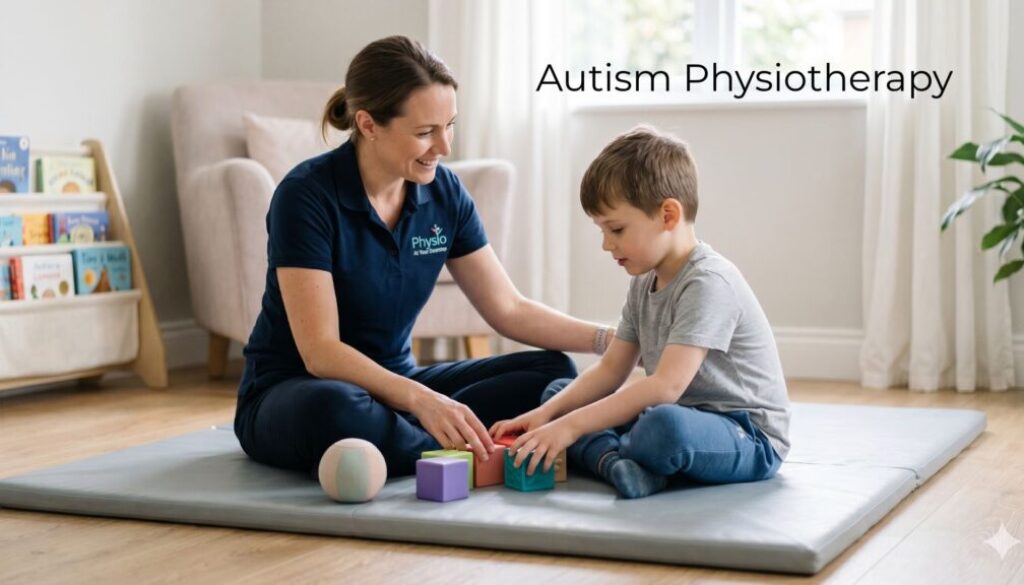
Home-based physiotherapy removes these barriers. The child is in their own space, with their own toys and routines nearby. The physiotherapist can observe the child in the actual environment where they spend most of their time and can tailor recommendations to fit seamlessly into the family’s daily life.
At Physio at Your Doorstep, we bring experienced physiotherapists directly to families across Bangalore, including JP Nagar, BTM Layout, Jayanagar, Koramangala, HSR Layout, and Whitefield. Same-day appointments are available, and sessions are entirely personalised to your child’s needs and temperament.
Explore our Pediatric Physiotherapy service to understand how we approach children with neurodevelopmental conditions, or read more on our Blogs page for related articles on child health and physiotherapy.
What to Expect From Autism Physiotherapy: Realistic Outcomes
Progress in physiotherapy for autism is gradual and individual. There is no universal timeline. Some children show noticeable improvements in balance and coordination within four to six weeks of consistent therapy. Others with more complex presentations may need longer-term support.
Realistic goals a physiotherapy programme might target include:
- Improved ability to walk on uneven surfaces without falling
- Better sitting posture and tolerance for seated tasks at school
- Development of age-appropriate gross motor skills (e.g., riding a bike, kicking a ball with accuracy)
- Reduced sensory sensitivity to movement and physical contact
- Greater independence in dressing, bathing, and other daily physical tasks
- Participation in recreational and social physical activities with peers
These outcomes are not trivial. Physical confidence and motor competence have a meaningful impact on a child’s social engagement, self-esteem, and overall quality of life.
Choosing the Right Physiotherapist for Your Child
Not every physiotherapist will have specific experience with autism and neurodevelopmental conditions. When choosing a physiotherapist for your child, look for someone who has training in paediatric physiotherapy, experience working with children with ASD, and the patience to build trust with a child who may initially resist engagement.
A good physiotherapist will be willing to go at the child’s pace, adapt their communication style, and work closely with your family. They will also collaborate with other professionals involved in your child’s care rather than working in isolation.
Book an Appointment with Physio at Your Doorstep today to get started with a comprehensive assessment in the comfort of your home.
Resources
- American Physical Therapy Association (APTA) Guide to Physical Therapy for ASD: choosept.com
- Physiopedia – Physiotherapy for ASD: physio-pedia.com
- MDPI Children – Two Physiotherapy Methods for ASD (2024): mdpi.com
- PMC – Multimodal Physiotherapy Approach for Autism: ncbi.nlm.nih.gov
This article is written for informational purposes and does not replace professional medical advice. If you have concerns about your child’s development, please consult a qualified healthcare professional.