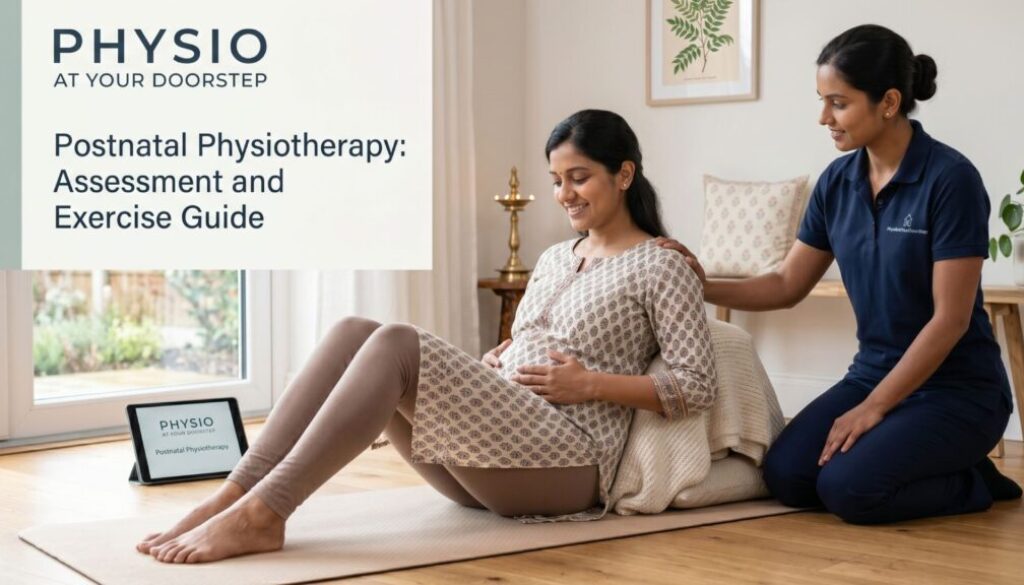
Postnatal Physiotherapy: Assessment and Exercise Guide
Giving birth is one of the most physically demanding events a body can experience. Yet, the postpartum period often called the “fourth trimester” receives far less clinical attention than pregnancy itself. Research published in Obstetrics and Gynecology (Wang et al., 2004) found that between 70% and 86% of women experience musculoskeletal pain during or after pregnancy, ranging from lower back pain and pelvic girdle dysfunction to urinary leakage and abdominal muscle separation.
A structured postnatal physiotherapy assessment is not a luxury. It is the evidence-based starting point for a safe, confident postpartum recovery. This guide walks you through exactly what such an assessment involves, which exercises help restore your core and pelvic floor, how conditions like diastasis recti are managed, and when it is safe to return to higher-impact physical activity.
What Is Postnatal Physiotherapy and Why Does It Matter?
Postnatal physiotherapy (also referred to as postpartum physiotherapy) is a specialised branch of women’s health physiotherapy focused on restoring musculoskeletal function, pelvic floor integrity, and overall physical well-being after childbirth. It covers vaginal deliveries as well as Caesarean sections, each of which creates a distinct recovery profile.
The physiological changes of pregnancy do not simply reverse the moment the baby is born. Hormonal surges of relaxin loosen connective tissue, the forward shift of the centre of gravity alters posture, and increased intra-abdominal pressure from the growing uterus stresses the pelvic floor and abdominal wall. Studies indicate that pelvic floor dysfunction, including urinary incontinence and pelvic organ prolapse, affects a significant proportion of women in the first postpartum year, yet many never seek specialised help because they believe these issues are “normal” after having a baby. They are common, but they are not inevitable, and they respond well to physiotherapy-led intervention.
“Physiotherapists are often well-placed among healthcare professionals to assess a woman’s fitness levels and provide support during her postpartum return to exercise.” — Physio-Pedia, Current Guidelines for Postnatal Exercise
Beyond the pelvic floor, postnatal physiotherapy addresses postural changes from breastfeeding and carrying an infant, scar tissue management after episiotomy or Caesarean incisions, sacroiliac joint pain, coccyx pain, and the gradual reintroduction of cardiovascular and strength exercise.
The Postnatal Physiotherapy Assessment: A Step-by-Step Breakdown
A thorough postnatal physiotherapy assessment is the foundation of any rehabilitation plan. Here is what a qualified physiotherapist evaluates during the initial session.
1. Detailed Obstetric and Medical History
The session begins with an in-depth discussion covering the type of delivery (vaginal or Caesarean), duration of labour, use of instruments (forceps or vacuum), any perineal tears or episiotomy, baby’s birth weight, and whether the mother is breastfeeding. Pre-existing musculoskeletal conditions, previous pelvic surgeries, or a history of urinary symptoms are also noted. This history allows the physiotherapist to anticipate which tissues may have been stressed and to tailor assessment accordingly.
2. Postural and Gait Assessment
Pregnancy creates predictable postural adaptations: an anterior pelvic tilt, increased lumbar lordosis, protracted shoulders, and a forward head posture from months of accommodating a growing bump. After delivery, these patterns often persist. The physiotherapist observes standing posture, assesses spinal curves, and evaluates gait to identify compensatory movement patterns that could lead to chronic pain if left unaddressed.
3. Core Muscle Assessment
The deep core unit comprising the transverse abdominis, multifidus, diaphragm, and pelvic floor functions as an integrated pressure management system. During and after pregnancy, this system is frequently disrupted. The physiotherapist assesses core muscle activation, endurance, and coordination, and specifically checks for diastasis recti abdominis (DRA), the separation of the rectus abdominis muscles along the linea alba. Research published in the British Journal of Sports Medicine (Sperstad et al., 2016) found that 39% of women still exhibit measurable diastasis at six months postpartum without a structured rehabilitation programme.
4. Pelvic Floor Muscle Assessment
This is a central component of the postnatal physiotherapy assessment. Using either external observation or internal vaginal palpation (with the patient’s informed consent), the physiotherapist evaluates pelvic floor muscle strength, endurance, coordination, and the ability to voluntarily relax the muscles. The assessment also looks for signs of hypertonic (overactive) pelvic floor muscles, which can cause pain during intercourse or incomplete bladder emptying. Screening tools such as the Pelvic Floor Distress Inventory (PFDI-20) may be used to identify symptomatic women and prioritise care.
5. Scar Assessment
For women who had a Caesarean section or an episiotomy, scar tissue assessment is a critical step. Adhesions, areas of hypersensitivity, and restricted scar mobility can affect pelvic floor function, bladder control, and even lower back pain long after the incision has healed. The physiotherapist assesses scar maturity, tissue mobility, and sensitivity, and begins scar desensitisation and mobilisation techniques at the appropriate time, usually around 6 to 8 weeks post-surgery, once the scar is fully closed.
6. Hip, Lower Back, and Sacroiliac Joint Examination
Pelvic girdle pain and lower back pain that began during pregnancy frequently persist postpartum if not treated. The physiotherapist examines the sacroiliac joints, pubic symphysis, hip range of motion, and lumbar spine mobility to identify any ongoing musculoskeletal dysfunction.
7. Functional Movement Screening
The physiotherapist evaluates how the woman performs daily tasks such as lifting the baby from a cot, getting up from the floor, and carrying a car seat to identify movements that create excessive intra-abdominal pressure or place undue load on the healing pelvic floor and core.
If you are in Bangalore and prefer a convenient assessment without leaving home, our Physiotherapy in Pregnancy and Postpartum service brings a qualified physiotherapist to your doorstep for a comprehensive evaluation.
Postpartum Physiotherapy Exercises: A Phase-Based Approach
One of the most common mistakes new mothers make is either attempting too much exercise too soon, or avoiding all movement out of caution. Evidence-based postnatal physiotherapy follows a staged, progressive framework. The following timeline reflects current international guidelines.
Phase 1: Days 1 to 6 Post-Delivery (Gentle Activation)
In the immediate postpartum phase, the goal is to gently activate the healing tissues, improve circulation, and reduce swelling. Even women who had a Caesarean section can begin these exercises within 24 hours of delivery with appropriate guidance.
- Diaphragmatic breathing: Lie on your back with knees bent. Inhale slowly so your belly rises. As you exhale, gently draw your lower belly inward. Hold 3 to 5 seconds and repeat for 5 minutes. This activates the transverse abdominis without straining the healing pelvic floor.
- Gentle pelvic floor contractions (Kegels): Contract the pelvic floor muscles as if stopping urine flow. Hold for 3 to 5 seconds and release fully. Begin with 5 to 10 repetitions twice daily. Ensure you can relax completely between contractions.
- Ankle pumps and heel slides: These promote venous return and reduce lower limb oedema, especially important for women at elevated thrombosis risk postpartum.
Phase 2: Weeks 2 to 6 (Foundation Building)
As acute healing progresses, exercises gradually increase in complexity. Progress should only happen if the previous phase is completed without symptoms such as increased bleeding, pelvic heaviness, urinary leakage, or pain.
- Supine core activation: Progress from diaphragmatic breathing to gentle transverse abdominis activation with leg slides and heel lifts, keeping the lower back in neutral position.
- Glute bridges: Lie on your back with knees bent and feet flat. Exhale and gently activate the pelvic floor before lifting the hips. Hold 2 to 3 seconds and lower slowly. Addresses the gluteal weakness that almost universally accompanies postpartum recovery.
- Seated and standing pelvic floor exercises: Progress Kegel exercises from lying to sitting and standing positions as strength improves.
- Gentle walking: Begin with 10-minute walks and build to 30 minutes over several weeks.
Phase 3: Weeks 6 to 12 (Functional Strength)
The traditional six-week clearance from an obstetrician indicates that wounds have healed, not that the pelvic floor and core have recovered. Physiotherapy-led progression in this phase focuses on functional strength.
- Squats and lunges: Begin with bodyweight only and a deliberate pelvic floor contraction before each repetition.
- Modified plank holds: Starting on hands and knees, extend one arm and the opposite leg, maintaining a neutral spine. Progress to a full plank only if no doming or coning of the abdomen is observed.
- Resistance band exercises: Side-lying hip abduction, clamshells, and standing hip exercises rebuild hip and gluteal strength that supports the pelvis.
Phase 4: 3 to 6 Months and Beyond (Return to Sport and Higher-Impact Activity)
International return-to-running guidelines published by Goom, Donnelly, and Brockwell (2019) recommend that women wait at least three months before resuming running or high-impact exercise postpartum, and only after passing specific physiotherapy benchmarks. These include single-leg balance for 10 seconds, 20 single-leg calf raises, 20 single-leg bridges, and 10 single-leg hops, all without symptoms of leakage or pelvic heaviness.
For women recovering from surgery, our Post-Surgical Physiotherapy service provides a structured rehabilitation pathway, including for Caesarean section recovery.
Diastasis Recti: Assessment, Symptoms, and Evidence-Based Management
Diastasis recti abdominis (DRA) is one of the most misunderstood conditions in postpartum care. It affects the majority of women by the third trimester and resolves spontaneously in many cases, but research confirms that 39% of women at six months postpartum still have a clinically significant inter-recti distance without a structured physiotherapy programme.
What Does DRA Look and Feel Like?
Common signs include a visible doming or coning along the midline of the abdomen during activities such as sitting up or lifting, a sense of weakness or instability in the midsection, lower back pain, and occasionally pelvic floor dysfunction. The size of the gap alone does not determine function; the ability of the linea alba to generate tension and transmit force is a more clinically meaningful measure.
Treatment: What the Research Shows
A systematic review published in the Brazilian Journal of Physical Therapy (Gluppe, Ellstrom Engh, and Bo, 2021) concluded that targeted exercise is the primary treatment of choice for DRA. Programmes that combine transverse abdominis activation, pelvic floor training, postural correction, and breathing modification show the most consistent results. A study by Thabet and Alshehri reported significant reductions in inter-recti separation following a deep core stability programme three times per week for eight weeks. A case study by Sheppard using progressive abdominal exercises over 16 weeks documented closure of the DRA gap by 88%.
Exercises to avoid in early DRA recovery include full sit-ups, double-leg lifts, heavy overhead pressing, and any movement that causes visible coning of the abdomen. The key principle is building intra-abdominal pressure management before adding external load.
|
DRA Phase |
Recommended Exercises |
Exercises to Avoid |
|
Weeks 1–6 |
Diaphragmatic breathing, heel slides, pelvic tilts, gentle Kegels |
Sit-ups, crunches, double-leg lifts, heavy lifting |
|
Weeks 6–12 |
Transverse abdominis activation, glute bridges, modified bird-dog, bodyweight squats |
Full planks (if coning occurs), overhead pressing, high-impact movement |
|
3–6 months |
Progressive core loading, functional compound movements, resistance training |
Exercises producing pain, leakage, or midline doming |
Pelvic Floor Rehabilitation After Childbirth
The pelvic floor is a hammock-like group of muscles and connective tissues that spans the base of the pelvis, supporting the bladder, bowel, and uterus, and playing a critical role in continence, sexual function, and spinal stability. Vaginal delivery, particularly a prolonged second stage or instrumental delivery, places significant stretch and compressive forces on these structures.
A randomised controlled trial (University of Alcala, NCT03247660) confirmed that pelvic-perineal physiotherapy, including pelvic floor muscle training and hypopressive exercises, significantly reduces the risk of pelvic floor dysfunction compared to lifestyle advice alone.
Types of Pelvic Floor Dysfunction Addressed in Postnatal Physiotherapy
- Stress urinary incontinence (SUI): Leakage of urine during coughing, sneezing, laughing, or exercise. Pelvic floor muscle training (PFMT) is the evidence-based first-line treatment, with supervised physiotherapy demonstrating superior outcomes compared to self-directed programmes.
- Pelvic organ prolapse: A feeling of heaviness or pressure in the pelvis. Physiotherapy-led pelvic floor rehabilitation significantly reduces symptoms and can reduce the grade of prolapse in mild to moderate cases.
- Hypertonic pelvic floor: An overactive, tight pelvic floor that struggles to relax. This can cause pain with intercourse, difficulty with bowel movements, and chronic pelvic pain. Treatment focuses on relaxation, stretching, and manual therapy, not strengthening.
- Coccydynia (tailbone pain): Pain at the base of the spine that can develop after a difficult vaginal delivery. Manual therapy to the coccyx and surrounding structures is an effective physiotherapy treatment.
Postpartum Pain Management: What Physiotherapy Can Treat
Pain is frequently normalised in the postpartum period, yet much of it is directly treatable with physiotherapy. Common conditions managed by postnatal physiotherapists include the following.
Lower Back Pain and Pelvic Girdle Pain
These are among the most prevalent postpartum complaints. The sacroiliac joints and pubic symphysis, loosened by relaxin during pregnancy, need time and targeted rehabilitation to restabilise. A physiotherapist uses manual therapy, muscle energy techniques, joint mobilisation, and progressive loading exercises to reduce pain and restore function.
If you experienced back pain during pregnancy, our Prenatal Physiotherapy During Pregnancy guide explains how early intervention can reduce postpartum complications.
De Quervain’s Tenosynovitis (Wrist Pain)
A frequently overlooked postpartum condition, De Quervain’s involves inflammation of the tendons on the thumb side of the wrist, caused by the repetitive movements of lifting and holding a newborn. Physiotherapy treatment includes splinting, activity modification, manual therapy, and graded strengthening.
Neck and Shoulder Pain from Breastfeeding Posture
Hours spent in a rounded forward posture during feeding create predictable neck and upper back tension. Postural correction advice, thoracic mobility exercises, and manual therapy provide significant relief.
Caesarean Scar Tissue Management
A Caesarean section involves cutting through seven layers of tissue. Scar adhesions that form during healing can restrict movement, affect bladder function, lower back pain, and pelvic floor mechanics. Physiotherapy scar massage and mobilisation, beginning around 6 to 8 weeks once the incision is fully closed, is an important part of every Caesarean recovery plan.
Postpartum Mental Health and the Role of Physical Activity
The relationship between postpartum physical recovery and mental health is well established. A review published in BMC Pregnancy and Childbirth (Daley et al., 2012) examined exercise as a treatment for postnatal depression and highlighted the psychological benefits of structured, supported physical activity for new mothers. This is a dimension of postnatal physiotherapy that is often absent from standard postpartum guides.
Physiotherapy provides a structured framework that gives women agency over their recovery, reduces fear of movement, and creates a supervised pathway back to the activities they value. Feeling physically stronger consistently correlates with improved mood and reduced anxiety in the postpartum period.
It is also worth noting that postpartum cardiovascular health deserves attention. During the initial postpartum year, women are at elevated risk of hypertension, thrombosis, and cardiac conditions. A physiotherapist monitors vital signs before and after activity in high-risk cases and collaborates with the obstetric team when clinically indicated.
At-Home Postnatal Physiotherapy in Bangalore: The Practical Advantage
One of the most significant barriers to postpartum physiotherapy is access. With a newborn at home, sleep deprivation, breastfeeding schedules, and the logistical challenge of travelling to a clinic, many women delay or skip the care they need. Research consistently confirms that fatigue and caregiving demands limit participation in in-person physiotherapy programmes, and these barriers disproportionately affect new mothers in the critical early postpartum weeks.
At-home physiotherapy eliminates this barrier entirely. At Physio at Your Doorstep, our qualified physiotherapists visit your home across Bangalore, covering JP Nagar, BTM Layout, Jayanagar, Koramangala, HSR Layout, Whitefield, and surrounding areas, to conduct postnatal assessments and deliver evidence-based treatment in a comfortable, familiar environment. Same-day appointments are available.
For mothers who prefer remote access, our Online Physiotherapy Consultation service provides expert guidance from anywhere in India.
Related Resources and Further Reading
- Physiotherapy in Pregnancy and Postpartum – Physio at Your Doorstep
- Prenatal Physiotherapy During Pregnancy: Your Complete Guide
- Post-Surgical Physiotherapy (including Caesarean Recovery)
- Online Physiotherapy Consultation India
- Orthopaedic Physiotherapy – Musculoskeletal Pain Management
- Physio at Your Doorstep Blog – All Articles
- Current Guidelines for Postnatal Exercise – Physio-Pedia
- Pregnancy & Postpartum Physical Therapy – APTA Pelvic Health
- Goom T, Donnelly G, Brockwell E. Returning to running postnatal – guidelines for medical, health and fitness professionals. Absolute Physio. 2019.
- Sperstad JB, et al. Diastasis recti abdominis during pregnancy and 12 months after childbirth. British Journal of Sports Medicine. 2016; 50(17): 1092–1096.
This article is written for informational purposes and does not replace professional medical advice. Always consult a qualified physiotherapist or healthcare provider before beginning any postpartum exercise programme.