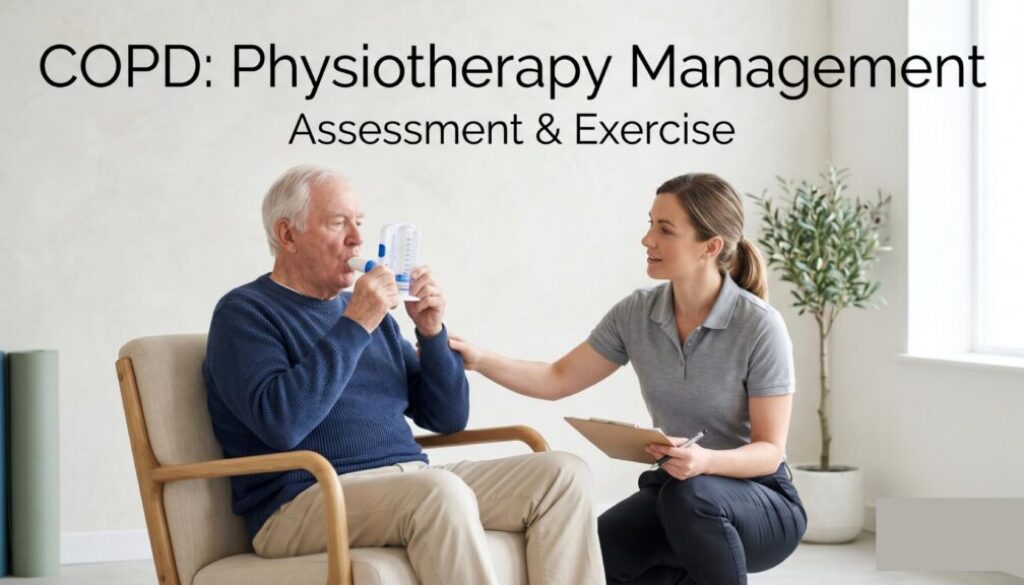
COPD Physiotherapy Management, Assessment & Exercise Guide
Chronic Obstructive Pulmonary Disease (COPD) has quietly become one of the most pressing public health challenges in India. According to a 2026 systematic review published in BMC Pulmonary Medicine, the pooled prevalence of COPD among Indian adults is approximately 13 percent, and the Global Burden of Disease report ranks COPD as the second leading cause of death and disability-adjusted life years (DALYs) in the country, with an estimated 37.8 million people affected. Add air pollution, biomass fuel exposure, occupational dust, and tobacco smoke into the equation, and the picture becomes clear: millions of Indians are struggling to take a full, comfortable breath every single day.
The good news is that COPD is manageable. While the disease cannot be reversed, structured physiotherapy can dramatically reduce breathlessness, improve exercise tolerance, prevent hospital readmissions, and restore independence. Physiotherapy is now recognized worldwide as a cornerstone of COPD care, alongside inhaled bronchodilators and smoking cessation.
This in-depth guide explains exactly how COPD physiotherapy management works in 2026, what a thorough assessment looks like, which exercises actually deliver results, and how a home-based pulmonary rehabilitation program can change the trajectory of the condition. Whether you are a patient, a caregiver, or a clinician, this article brings together the latest evidence from the Global Initiative for Chronic Obstructive Lung Disease (GOLD) 2024 report, the American Thoracic Society/European Respiratory Society (ATS/ERS), the American College of Sports Medicine (ACSM), and recent Indian and global clinical trials.
What is COPD? A Quick Primer Before We Go Deeper
COPD is a chronic, progressive lung disease characterized by persistent airflow limitation that is not fully reversible. It is usually a mix of two underlying conditions:
Chronic bronchitis, in which the airways become inflamed and produce excess mucus, leading to a persistent productive cough.
Emphysema, in which the tiny air sacs (alveoli) in the lungs are damaged, reducing the surface area available for oxygen exchange and trapping air inside the lungs (hyperinflation).
The most common symptoms include breathlessness (dyspnea) on exertion, chronic cough, sputum production, wheezing, chest tightness, fatigue, and frequent respiratory infections. Over time, patients often experience skeletal muscle dysfunction, weight loss, anxiety, depression, and a steep decline in their ability to perform activities of daily living.
While smoking remains the leading risk factor, biomass fuel exposure (particularly in rural Indian households where wood, dung, or crop residue is burned for cooking), occupational exposure to dust and chemicals, air pollution, untreated childhood respiratory infections, and genetic factors like alpha-1 antitrypsin deficiency all play significant roles.
Why Physiotherapy Is Central to COPD Management
The 2024 GOLD report continues to recommend pulmonary rehabilitation, with supervised exercise training as its core component, for nearly every symptomatic COPD patient. Drug therapy alone cannot address the systemic effects of COPD, particularly deconditioning, muscle wasting, breathing pattern disorders, retained secretions, and the psychological burden of breathlessness.
A trained respiratory or pulmonary physiotherapist tackles five problems that medications cannot fully solve on their own:
- Reducing the work of breathing through positioning and breathing retraining
- Clearing thick, retained secretions from the airways
- Reversing peripheral muscle deconditioning through targeted exercise
- Teaching pacing, energy conservation, and dyspnea management strategies
- Building self-efficacy so patients can manage flare-ups confidently at home
Research consistently shows that patients who complete a structured physiotherapy and pulmonary rehabilitation program walk further, climb stairs more easily, sleep better, experience fewer exacerbations, and report meaningful improvements in quality of life. A six-month physiotherapy protocol in patients with GOLD stage II to III COPD produced statistically significant improvements in the six-minute walk test and the modified Medical Research Council (mMRC) dyspnea scale, with benefits sustained well beyond the intervention period.
If you live in Bangalore and want structured, home-based care, the team at Physio at Your Doorstep offers specialized Pulmonary Physiotherapy services delivered right in your living room, so travel isn’t a barrier to consistent attendance.
COPD Physiotherapy Assessment: The Foundation of Effective Treatment
No two COPD patients are the same. A 58-year-old former smoker with mild airflow limitation but significant anxiety is a completely different clinical picture from an 82-year-old with severe emphysema, frequent exacerbations, and muscle wasting. This is why a rigorous, multi-dimensional assessment is the most important step in COPD physiotherapy management. It is the foundation on which every exercise, every breathing technique, and every progression decision is built.
A complete physiotherapy assessment for COPD typically includes the following components.
1. Detailed Subjective History
The physiotherapist begins by understanding the patient as a person, not just a set of lungs. Key questions include the duration and pattern of symptoms, smoking history (in pack-years), occupational and environmental exposures, frequency of exacerbations and hospitalizations in the past year, current medications and inhaler technique, comorbidities (hypertension, diabetes, ischemic heart disease, osteoporosis, anxiety, and depression are common in COPD), nutritional status, social support, and personal goals. Asking the patient what they cannot do that they wish they could, whether it is playing with grandchildren, walking to the local market, or attending a wedding, anchors the entire treatment plan to a meaningful outcome.
2. Symptom Severity Scales
Two questionnaires dominate global practice:
The modified Medical Research Council (mMRC) Dyspnea Scale grades breathlessness from 0 (only breathless with strenuous exercise) to 4 (too breathless to leave the house or breathless while dressing).
The COPD Assessment Test (CAT) is an 8-item questionnaire scoring cough, phlegm, chest tightness, breathlessness, activity limitation, confidence, sleep, and energy on a 0 to 5 scale, with a maximum score of 40. A score above 10 indicates significant symptom impact.
These tools, used together, allow the physiotherapist to track real change over weeks and months rather than relying on subjective impressions.
3. Objective Physical Examination
Observation is powerful. The physiotherapist looks for the characteristic barrel chest of hyperinflation, use of accessory neck muscles, pursed-lip breathing at rest, central or peripheral cyanosis, finger clubbing, peripheral edema (a sign of right-sided heart strain), and the patient’s preferred posture. Chest auscultation identifies wheezes, crackles, or reduced breath sounds. Chest expansion is measured at the axilla, nipple line, and xiphoid level using a tape, and palpation assesses diaphragmatic excursion and accessory muscle tension.
Vital signs include resting and exertional oxygen saturation via pulse oximetry, respiratory rate, heart rate, and blood pressure. A drop in SpO2 below 88 percent during activity is a red flag that informs the need for supplemental oxygen during training.
4. Functional Capacity Testing
The six-minute walk test (6MWT) is the gold-standard field test in COPD. The patient walks as far as possible on a flat 30-meter corridor in six minutes, with rests permitted. The distance covered, along with SpO2 and Borg dyspnea scores before and after, gives an objective benchmark for exercise prescription and tracks progress over time. A change of around 30 meters is considered clinically meaningful.
The incremental shuttle walk test and endurance shuttle walk test are alternatives that are particularly useful in research and structured rehab settings.
5. Respiratory Muscle Strength
Maximum inspiratory pressure (MIP) and maximum expiratory pressure (MEP) measurements, taken with a hand-held pressure manometer, identify patients who would benefit from inspiratory muscle training, a frequently overlooked but evidence-supported intervention.
6. Activities of Daily Living and Quality of Life
The Barthel Index quantifies independence in basic ADLs like bathing, dressing, and stair climbing. Disease-specific tools like the St. George’s Respiratory Questionnaire capture the impact of COPD on day-to-day life and emotional wellbeing.
This comprehensive baseline assessment, repeated every two to four weeks, becomes the dashboard that guides every clinical decision. Patients can read more about the broader principles behind such evaluations in our blog on Neurological Physiotherapy Tests for Patient Evaluation, which explains many of the same evidence-based assessment philosophies applied across physiotherapy specialties.
Core COPD Physiotherapy Management Techniques
Once the assessment is complete, the physiotherapist constructs a tailored treatment plan. Stable COPD and acute exacerbations require different approaches, and the techniques below are selected and combined based on the patient’s specific presentation.
Breathing Retraining Techniques
These are the bread-and-butter interventions that every COPD patient should master.
Pursed-Lip Breathing (PLB): The patient inhales gently through the nose for about two seconds, then exhales slowly through pursed lips (as if blowing out a candle) for four to six seconds. PLB creates a small back-pressure in the airways that prevents premature airway collapse, slows the respiratory rate, reduces carbon dioxide retention, and improves oxygen saturation. It is the single most useful technique a COPD patient can carry in their pocket for sudden episodes of breathlessness.
Diaphragmatic (Abdominal) Breathing: The patient places one hand on the chest and one on the abdomen, then breathes in slowly through the nose while focusing on raising the abdominal hand more than the chest hand. This retrains the diaphragm, which is often pushed into a mechanically disadvantaged flattened position in COPD due to hyperinflation, to do more of the breathing work. Stronger, more efficient diaphragmatic action reduces the load on the accessory neck and shoulder muscles.
Active Cycle of Breathing Technique (ACBT): A structured sequence of breathing control, three to four deep thoracic expansion breaths, more breathing control, and one or two forced huffs. ACBT is highly effective for mobilizing and clearing secretions in patients with chronic productive cough or bronchiectasis-overlap presentations.
Paced Breathing: Patients are taught to synchronize breathing with movement. For example, breathe in while stepping with one foot and breathe out across two or three steps. This is invaluable for walking, climbing stairs, and any rhythmic activity.
Airway Clearance Techniques
For COPD patients with copious or sticky secretions, retained mucus causes infection, worsens airflow obstruction, and triggers exacerbations.
Postural Drainage: Specific body positions allow gravity to drain mucus from different lung segments. The physiotherapist teaches patients and caregivers safe positions to use at home.
Manual Chest Physiotherapy: Percussion (rhythmic cupped-hand clapping over the affected lung area) and vibration (gentle oscillation during exhalation) help loosen retained secretions. While the routine use of percussion in acute exacerbations is no longer universally recommended, individual patients with sputum retention still benefit.
Forced Expiration Technique (Huffing): A short, sharp “huff” with an open mouth, like fogging a mirror, moves secretions up the airways with less airway collapse than a hard cough.
Positive Expiratory Pressure (PEP) Devices: Tools like the Flutter, Acapella, and Aerobika create back-pressure during exhalation and oscillating airflow that loosens mucus. These are particularly useful for home-based self-management.
Manual Therapy for the Respiratory System
Two techniques are gaining strong evidence in COPD care:
Manual Diaphragm Release Technique: A soft-tissue mobilization performed by the physiotherapist on the lower costal margin. A 2019 randomized crossover trial demonstrated that this technique significantly improved diaphragmatic excursion in patients with mild to moderate COPD compared to a diaphragmatic stretch alone.
Thoracic Mobilization and Posture Correction: Chronic hyperinflation, kyphosis, and forward-head posture mechanically restrict breathing. Gentle thoracic spine mobilizations, scapular retraction work, and chest wall stretching can measurably improve chest expansion and reduce the work of breathing.
Positioning for Breathlessness Relief
When breathlessness strikes, the right position can be more powerful than any medication. The most effective positions, supported by the Association of Chartered Physiotherapists in Respiratory Care, include:
- Sitting leaning forward with arms resting on the thighs or a table (tripod position)
- High side-lying with the head and upper chest supported on pillows
- Standing leaning forward against a wall or kitchen counter
- Sitting upright with the back supported and shoulders relaxed
These positions fix the shoulder girdle, allowing the accessory muscles of inspiration (sternocleidomastoid, scalenes, pectorals) to work more efficiently.
Exercise Prescription in COPD: The FITT Framework
Exercise is the single most powerful intervention in COPD physiotherapy. The 2024 ATS/ERS pulmonary rehabilitation statement and the ACSM Guidelines for Exercise Testing and Prescription converge on individualized programs built around the FITT principle: Frequency, Intensity, Time, and Type.
Aerobic (Endurance) Training
Frequency: 3 to 5 sessions per week Intensity: Moderate to high, typically 60 to 80 percent of peak work rate or a Borg dyspnea rating of 4 to 6 out of 10 Time: 20 to 60 minutes per session, including warm-up and cool-down Type: Walking (overground or treadmill), stationary cycling, marching in place
Walking is the most accessible and best-tolerated modality for Indian patients. Cycle ergometry is excellent for patients with balance issues, knee pain, or significant exertional desaturation because the lower oxygen cost makes it easier to sustain exercise.
For severely deconditioned patients who cannot sustain continuous exercise, interval training (for example, one minute of higher-intensity walking alternated with one minute of low-intensity walking) delivers comparable benefits with less perceived breathlessness.
Strength (Resistance) Training
Skeletal muscle dysfunction is now recognized as a hallmark feature of COPD, not just a consequence. Quadriceps strength independently predicts mortality. The ATS/ERS statement specifically recommends including resistance training in every pulmonary rehabilitation program.
Frequency: 2 to 3 non-consecutive days per week Intensity: 60 to 70 percent of one-repetition maximum, progressing as tolerated Time: 2 to 4 sets of 8 to 12 repetitions Type: Major muscle groups, with priority on the legs (squats, sit-to-stands, leg press, step-ups), upper limbs (biceps curls, shoulder press), and core
Patients who have undergone surgery or have complex post-operative recovery needs may benefit from the principles outlined in our Post Surgical Physiotherapy service, where progressive resistance training is similarly tailored to functional recovery.
Upper Limb Exercises
Many everyday tasks like lifting groceries, brushing hair, hanging laundry, and bathing involve unsupported arm work, which is particularly fatiguing in COPD because the shoulder girdle muscles also act as accessory respiratory muscles. Supported arm ergometry and dumbbell exercises specifically train this capacity and produce real-world improvements in ADL performance.
Inspiratory Muscle Training (IMT)
For patients with documented inspiratory muscle weakness (MIP less than 60 cmH2O), threshold IMT devices can be used at 30 to 50 percent of MIP for 15 to 30 minutes daily. Recent evidence suggests benefits in dyspnea, exercise tolerance, and even quality of life.
Flexibility and Balance
Stretching of the pectorals, hip flexors, hamstrings, and calves is included in every session to counter the postural changes of COPD. Balance training, particularly in older patients, reduces fall risk, which is significant given the high prevalence of comorbid osteoporosis. For older adults, our blog on Geriatric Problems and Its Physiotherapy Management explores the synergies between balance, strength, and chronic disease management in detail.
Pulmonary Rehabilitation: The Structured Program
Pulmonary rehabilitation is the formalized, multi-disciplinary application of all the techniques above, typically delivered over 6 to 12 weeks with two to three supervised sessions per week. A standard program runs through three phases:
Phase 1 (Initiation, 4 to 6 weeks): Baseline assessment, education on COPD pathophysiology, inhaler technique, smoking cessation, breathing retraining, and the gradual introduction of low-intensity exercise.
Phase 2 (Conditioning, 4 to 8 weeks): Progressive intensification of aerobic and resistance training, mastery of airway clearance techniques, energy conservation strategies, dietary counseling, and psychological support for anxiety and depression.
Phase 3 (Maintenance, ongoing): Transition to long-term self-management with structured home exercise, periodic check-ins with the physiotherapist, action plans for exacerbations, and integration of physical activity into daily life.
For patients hospitalized with an acute exacerbation, the ERS/ATS guidelines recommend referral to pulmonary rehabilitation within three weeks of discharge. This window is critical, because early rehab has been shown to reduce readmissions and mortality.
Home-Based COPD Physiotherapy: Why It Works for Indian Patients
A common reason patients drop out of hospital-based pulmonary rehabilitation is simple: getting there is hard. Bangalore traffic, dependence on caregivers, exertional breathlessness during the commute itself, and the stigma of being seen as unwell all combine to reduce attendance. Recent research has shown that home-based and tele-rehabilitation programs deliver outcomes that are comparable to centre-based programs when delivered by trained physiotherapists.
Home-based COPD physiotherapy offers several distinct advantages:
- The environment is familiar, comfortable, and free of infection risk
- The physiotherapist sees the patient’s actual living conditions and can modify stairs, kitchens, and bathrooms to support breathing
- Family members are present and can be trained as active partners in care
- Sessions can be timed around medication peaks, meals, and energy levels
- Travel-related fatigue is eliminated, allowing more energy for the actual workout
For homebound, elderly, or post-hospital-discharge patients in Bangalore, services like Physio at Your Doorstep provide qualified physiotherapists who deliver structured pulmonary rehabilitation in the patient’s own home. Sessions integrate breathing retraining, airway clearance, supervised exercise, and family education, all wrapped into a single visit.
Special Considerations: Comorbidities, Exacerbations, and Long-Term Care
Managing Acute Exacerbations (AECOPD)
During an acute exacerbation, deep breathing exercises that increase lung volume can actually worsen dyspnea by increasing hyperinflation. Physiotherapy during AECOPD focuses instead on controlled breathing, pursed-lip breathing, positioning, gentle mobilization, airway clearance only if sputum retention is significant, and assistance with non-invasive ventilation if prescribed. Early mobilization within the first 48 hours of hospital admission, even if just sitting on the edge of the bed and standing, has been shown to preserve quadriceps strength and reduce length of stay.
Comorbidities
COPD rarely travels alone. Cardiovascular disease, type 2 diabetes, sarcopenia, osteoporosis, anxiety, and depression all influence exercise prescription. A consensus statement from the EXPERT Working Group emphasizes that exercise training must be individualized to address these comorbidities, blending principles of pulmonary and cardiac rehabilitation.
Smoking Cessation and Education
Physiotherapists are uniquely positioned to reinforce smoking cessation messages because they spend more time with the patient than any other healthcare provider. Combined with patient education on inhaler technique, vaccination, nutrition, and exacerbation action plans, this education multiplies the benefit of the physical interventions.
Measuring Progress: What Improvement Looks Like
A successful COPD physiotherapy program should produce measurable change. Realistic, evidence-based goals over 8 to 12 weeks include:
- An improvement of 30 meters or more on the six-minute walk test
- A reduction of one or more points on the mMRC dyspnea scale
- A reduction of two or more points on the CAT score
- Increased independence in ADLs, captured on the Barthel Index
- Improved peripheral muscle strength (typically measured by sit-to-stand counts or hand-held dynamometry)
- Fewer unscheduled GP visits, emergency department visits, and hospitalizations
Most patients begin to feel real changes by the third or fourth week, with the largest gains in the second and third months. Maintenance work for the rest of life is non-negotiable.
Putting It All Together: A Sample Weekly Plan for a Stable COPD Patient
For a 65-year-old patient with GOLD stage II COPD, the home-based week might look like this:
- Monday, Wednesday, Friday: 30 to 40 minutes of supervised physiotherapy combining warm-up, pursed-lip and diaphragmatic breathing review, 20 minutes of walking or marching at moderate intensity with Borg 4 to 5, two to three resistance exercises for the legs and arms, and cool-down stretching.
- Tuesday, Thursday: 20 minutes of independent walking at the same intensity, plus a short airway clearance session with ACBT and a PEP device if prescribed.
- Saturday: A longer outdoor or terrace walk at a comfortable pace, with the family.
- Sunday: Active rest, with gentle stretching and a focus on breathing practice.
- Daily: Inhaler technique, posture awareness, pacing during chores, and tracking symptoms in a diary.
The Bottom Line
COPD physiotherapy management is no longer a “nice-to-have” add-on to medications. It is a frontline, evidence-backed intervention recommended by every major respiratory guideline in 2026, including GOLD, ATS/ERS, ACSM, and the British Thoracic Society. A rigorous assessment, tailored breathing retraining, targeted airway clearance, individualised exercise prescription, and structured pulmonary rehabilitation can transform what feels like a slow, frightening decline into a manageable, active life.
The greatest barrier most patients face is not the disease itself but access to consistent, expert care. That is exactly the gap that home-based services exist to fill. If you or a loved one is living with COPD in Bangalore and would like a personalised assessment and home-based pulmonary rehabilitation program, the experienced respiratory physiotherapists at Physio at Your Doorstep can help you take that first deep breath toward a fuller life. You can explore the dedicated Pulmonary Physiotherapy service page or book an appointment to schedule an initial home visit.
Trusted Resources for Further Reading
- Global Initiative for Chronic Obstructive Lung Disease (GOLD) 2024 Report: https://goldcopd.org
- American Thoracic Society Patient Information on Pulmonary Rehabilitation: https://www.thoracic.org
- Cochrane Review: Pulmonary Rehabilitation for COPD: https://www.cochrane.org
- Journal of Physiotherapy, Holland AE: Physiotherapy Management of Acute Exacerbations of COPD: https://www.sciencedirect.com/science/article/pii/S1836955314001295
- BMC Pulmonary Medicine, Burden of COPD Among Indian Adults (2026 Systematic Review): https://link.springer.com/article/10.1186/s12890-026-04134-0
- Lung India, True Burden of COPD in India: https://journals.lww.com/lungindia/fulltext/2021/11000/what_is_the_true_burden_of_chronic_obstructive.1.aspx
Disclaimer: This article is for educational purposes and does not replace personalized medical or physiotherapy advice. Please consult a qualified pulmonologist and a registered physiotherapist for an individualized assessment and treatment plan.
Frequently Asked Questions (FAQ)