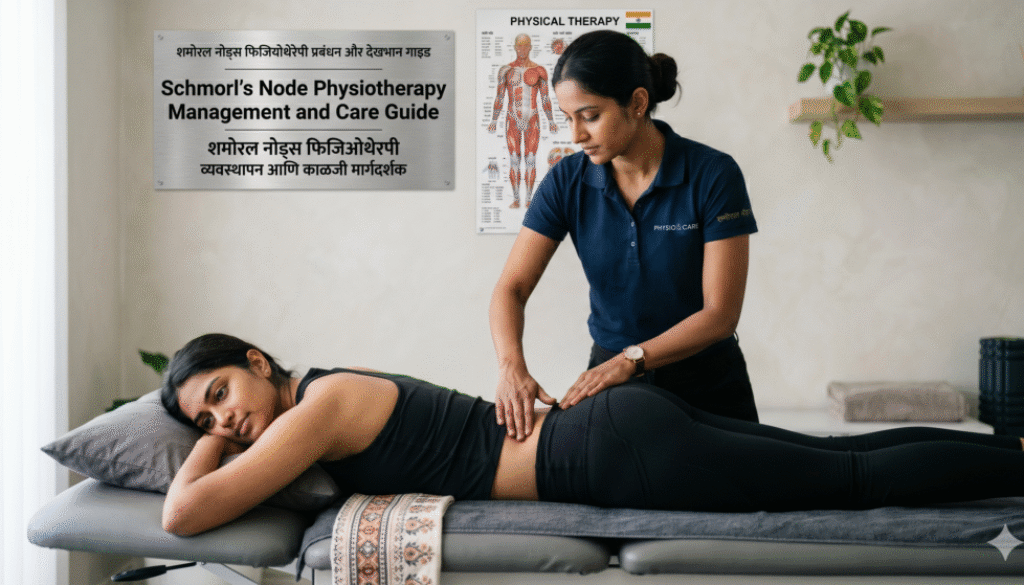
Schmorl’s Node Physiotherapy Management: Rehab Guide
If you have been diagnosed with a Schmorl’s node or discovered one incidentally on a spinal MRI, you may have walked away with more questions than answers. What exactly is this condition? Will it cause long-term back pain? And most importantly, how does physiotherapy help you recover from it? This guide breaks everything down clearly so you can move forward with confidence.
What Is a Schmorl’s Node?
A Schmorl’s node is a type of vertical disc herniation where the soft inner material of an intervertebral disc pushes upward or downward through a weakened area in the vertebral endplate and into the spongy bone of the vertebral body itself. Unlike a traditional disc herniation that bulges outward and presses on nerve roots, Schmorl’s nodes herniate inward into the vertebra.
The condition is actually quite common. Research suggests that Schmorl’s nodes are detected in approximately 38% to 75% of the population, with a higher prevalence among males. Most people who have them never experience a single symptom and the nodes are discovered only by chance during imaging for an unrelated concern. However, in a smaller percentage of individuals, Schmorl’s nodes can become a genuine source of spinal pain, stiffness, and reduced mobility, and that is where professional physiotherapy management becomes essential.
The term was named after the German pathologist Christian Georg Schmorl, who first described the finding in the early 20th century after examining post-mortem spine specimens.
What Causes Schmorl’s Nodes?
Understanding the root cause helps shape the most appropriate physiotherapy treatment plan. Several factors contribute to the development of these spinal lesions.
Genetic Predisposition
Research published in Arthritis and Rheumatism found that Schmorl’s nodes are highly heritable. Studies estimate that up to 70% of individuals diagnosed with the condition have a genetic predisposition, meaning the structural composition of their vertebral endplates may be inherently weaker than average.
Age-Related Spinal Degeneration
As the spine ages, the intervertebral discs lose water content and the endplates gradually weaken. This degenerative process is the most common cause in adults over 40, making Schmorl’s nodes a frequent incidental finding in routine lumbar or thoracic spine imaging.
Acute Mechanical Trauma
Sudden high-impact loading of the spine, such as a fall, heavy lifting, or axial compression injuries during sports, can fracture the endplate and allow disc material to herniate through. This type of traumatic Schmorl’s node is more likely to be symptomatic and is particularly relevant in young athletes and physically active individuals.
Osteoporosis and Metabolic Bone Disease
When bone density decreases, the vertebral body loses its structural integrity and becomes more susceptible to endplate failure. Osteoporosis is therefore a well-established contributing factor, and some research also points to vitamin D deficiency as a coinciding variable in certain presentations.
Repetitive Spinal Loading
Activities that place continuous compressive stress on the spine over long periods, including heavy manual labor, certain occupational postures, and high-impact sports like gymnastics or weightlifting, can gradually weaken the endplate and promote node formation.
Inflammatory Conditions
Conditions such as Scheuermann’s disease, which causes kyphotic deformity in adolescents, are frequently associated with multiple Schmorl’s nodes in the thoracic and thoracolumbar spine.
How Does a Schmorl’s Node Cause Back Pain?
The majority of Schmorl’s nodes are entirely asymptomatic. However, when symptoms do occur, several mechanisms are responsible.
Local Inflammation
When disc material pushes through the endplate, it can trigger an acute inflammatory response in the surrounding vertebral bone. This bone edema, visible on MRI as a bright signal change, is often the primary source of localized pain in symptomatic cases.
Disrupted Spinal Biomechanics
The presence of a Schmorl’s node alters the load distribution across the affected spinal segment. This change in mechanics increases stress on adjacent structures, including facet joints, ligaments, and surrounding discs, and can accelerate degenerative changes over time.
Nerve Irritation
In rare cases, the inflammatory reaction around an active Schmorl’s node may irritate nearby nerve roots, leading to referred pain, radiating symptoms down the leg (similar to sciatica), or localized tenderness.
Secondary Disc Degeneration
Because the endplate plays a critical role in providing nutrition to the avascular intervertebral disc, a damaged endplate can compromise disc health and accelerate degeneration at that spinal level.
Symptoms of Schmorl’s Node
Because the condition spans a wide spectrum from completely silent to moderately painful, it is important to recognize both presentations.
When Schmorl’s Nodes Are Asymptomatic
In the majority of cases, there are no symptoms at all. The individual has no idea the node exists until it appears incidentally on an X-ray, CT scan, or MRI ordered for another reason.
When Schmorl’s Nodes Are Symptomatic
When symptoms are present, they typically include:
- Localized back pain at the level of the affected vertebra, often described as a deep, aching, or sharp discomfort
- Pain that worsens with prolonged sitting, bending forward, or lifting
- Stiffness in the thoracic or lumbar spine, particularly in the morning or after periods of inactivity
- Reduced range of motion in the spine
- Occasional muscle spasms in the paraspinal region
- In rarer cases, radiating pain or tingling into the lower limbs when nerve involvement is present
Symptoms can range in duration from a few weeks in acute presentations to several months in chronic or recurrent cases, especially when the underlying cause is not addressed.
How Is Schmorl’s Node Diagnosed?
If a Schmorl’s node is suspected, your doctor will typically request imaging studies. A standard X-ray may show indentation of the vertebral endplate, but MRI is widely considered the gold-standard diagnostic tool because it reveals not only the node itself but also the surrounding bone marrow edema that indicates whether the node is active and symptomatic.
In some cases of persistent unexplained back pain, provocative discography may be performed to confirm whether the affected disc is the actual pain generator. A thorough physiotherapy assessment will additionally evaluate posture, spinal mobility, core muscle strength, movement patterns, and functional limitations to design a personalized treatment plan.
Physiotherapy Management of Schmorl’s Node: A Comprehensive Approach
Physiotherapy is the cornerstone of conservative management for symptomatic Schmorl’s nodes. A 2025 case report published in the Journal of Clinical and Diagnostic Research confirmed that a comprehensive physiotherapeutic approach combining electrotherapy, manual therapy, exercise therapy, and postural education produced significant improvement in pain, core strength, and functional outcomes in a patient with lumbar Schmorl’s node.
At Physio at Your Doorstep, our experienced physiotherapists bring this evidence-based care directly to your home in Bangalore, removing the barrier of travel during pain and recovery.
Phase 1: Acute Pain Management (Week 1 to 2)
The first priority in the acute phase is reducing pain and inflammation so that active rehabilitation can begin safely.
Cryotherapy and Thermotherapy
Ice application over the affected spinal segment for 15 to 20 minutes every two to three hours during the acute phase helps control local inflammation. As the acute phase settles, heat therapy may be introduced to relax paraspinal muscle spasm.
Electrotherapy Modalities
Depending on the clinical picture, your physiotherapist may use Transcutaneous Electrical Nerve Stimulation (TENS), interferential therapy, or ultrasound therapy to achieve pain relief and accelerate tissue healing. LASER therapy and TECAR therapy are advanced electrotherapy options that promote faster resolution of bone edema and soft tissue inflammation.
Soft Tissue Techniques
Gentle effleurage and manual soft tissue release techniques help drain excess extracellular fluid from congested paraspinal tissues and reduce protective muscle guarding.
Lumbar Support and Postural Guidance
In some acute or traumatic cases, a lumbar support orthotic may be prescribed for short-term use to reduce compressive loading on the affected segment while healing progresses.
Phase 2: Spinal Mobility and Core Activation (Week 2 to 6)
Once acute pain is under control, the focus shifts to restoring normal spinal movement and activating the deep core stabilizing muscles.
Manual Therapy and Joint Mobilization
Skilled joint mobilization techniques applied to hypomobile segments of the lumbar or thoracic spine help restore normal intervertebral movement, reduce stiffness, and improve spino-pelvic mobility. This is a key distinction from simply resting, as passive immobility can actually worsen long-term outcomes.
Core Stability Training
The deep core muscles, specifically the transversus abdominis, multifidus, and pelvic floor, form the essential corset of stability for the lumbar spine. Targeted activation exercises such as abdominal bracing, dead bugs, and four-point kneeling exercises progressively retrain these muscles to share the load and reduce stress on the damaged endplate.
A 2014 clinical case study published in the Global Journal of Medical and Clinical Case Reports confirmed that an 8-week physical therapy program incorporating core stability exercises allowed a 12-year-old athlete with Schmorl’s nodes to return to competitive soccer with significantly reduced back pain.
Neural Mobilization
If sciatic nerve irritation or referred leg pain is present, nerve mobilization techniques such as sciatic nerve flossing are incorporated to restore neural mobility and reduce radicular symptoms.
Stretching and Flexibility Work
Sustained stretching of the hip flexors, hamstrings, gastrocnemius, and thoracolumbar fascia helps reduce excessive loading on lumbar structures during functional movements. Spinal mobility exercises such as cat-camel stretches, pelvic tilts, and lumbar rotations are progressed gradually.
Phase 3: Functional Strengthening and Load Management (Week 6 to 12)
As the patient’s pain decreases and mobility improves, the rehabilitation program progresses toward building the strength and endurance needed for daily activities and, where applicable, return to sport.
Progressive Resistance Training
Exercises such as wall-assisted squats, bridges, bird-dogs, and resisted row variations build the larger spinal extensor and hip musculature. The progression follows a careful load management approach, ensuring that spinal compression remains within safe limits throughout.
Postural Retraining
Poor posture, particularly prolonged slouching or forward head posture associated with desk work, amplifies compressive forces through the vertebral endplates. Physiotherapists provide detailed instruction on ergonomic positioning during sitting, standing, and lifting that is then reinforced through practical home exercises.
Gait and Movement Pattern Correction
Functional movement analysis identifies compensatory patterns that place abnormal stress on the spine. Correcting how a patient bends, carries loads, or gets up from a seated position is a fundamental component of long-term recovery and relapse prevention.
Low-Impact Aerobic Exercise
Brisk walking for 3000 to 5000 steps daily is a practical and effective way to maintain cardiovascular health, improve spinal nutrition through movement, and support weight management, all of which reduce compressive loading on the lumbar spine.
Phase 4: Long-Term Spinal Health and Relapse Prevention
The final stage of physiotherapy management focuses on sustaining the gains made during rehabilitation and equipping the patient with the tools to self-manage their spine over the long term.
Neuromuscular and Proprioceptive Training
Balance and proprioceptive exercises using unstable surfaces or single-leg activities challenge the spine’s reflex stabilization system and improve automatic protective muscle responses during everyday movement.
Education on Spinal Ergonomics
Patients learn how to protect their spine during occupational tasks, household activities, and recreational pursuits. Understanding which movements and postures load the spine favorably versus unfavorably gives patients genuine long-term control over their condition.
Home Exercise Program
A structured home exercise program allows patients to maintain core strength, flexibility, and postural alignment independently between physiotherapy sessions and after formal treatment concludes.
Physiotherapy for Schmorl’s Node vs. Surgical Management
The vast majority of individuals with symptomatic Schmorl’s nodes respond well to conservative physiotherapy without ever requiring surgery. Surgery is considered only in extremely rare cases where there is severe nerve compression or progressive neurological deficit that does not respond to conservative measures over several months.
According to published clinical data, symptoms typically resolve with conservative management within two weeks to six months depending on the severity of the presentation. This is why initiating physiotherapy early and consistently is so important.
How Our Home Physiotherapy Service Helps You Recover Faster
Recovering from Schmorl’s node pain while managing travel to a clinic can feel overwhelming, particularly during the acute phase when movement is uncomfortable. Our Orthopaedic Physiotherapy service brings qualified physiotherapists directly to your door anywhere in Bangalore, including JP Nagar, BTM Layout, Jayanagar, Koramangala, HSR Layout, and Whitefield.
Your physiotherapist will conduct a thorough clinical assessment at your home, design a personalized rehabilitation program based on your imaging findings and functional limitations, and guide you through each phase of recovery in the comfort of your own space.
For those who prefer remote guidance or live outside Bangalore, our Online Physiotherapy Consultation service allows you to access the same expert care through a video call, with a detailed exercise program delivered digitally.
If your Schmorl’s node is associated with a post-surgical spine condition, our Post Surgical Physiotherapy team has the experience to support your recovery safely and effectively.
What to Avoid During Schmorl’s Node Recovery
Knowing what not to do is just as important as knowing the right exercises.
- Avoid heavy axial loading exercises such as barbell squats, deadlifts, and overhead presses until your physiotherapist gives clearance
- Avoid prolonged sitting without lumbar support or regular movement breaks
- Avoid high-impact sports such as running on hard surfaces, gymnastics, or contact sports during the acute phase
- Avoid sudden trunk rotation under load
- Do not ignore worsening pain, new neurological symptoms such as leg weakness or bladder changes, or fever alongside back pain, as these require urgent medical review
Recovery Timeline: What to Realistically Expect
The recovery trajectory for Schmorl’s node varies considerably based on whether the presentation is acute or chronic, the degree of bone edema on MRI, the patient’s age, baseline fitness, and adherence to rehabilitation.
A realistic overview:
Weeks 1 to 2: Pain reduction, inflammation control, and gentle mobility restoration are the primary goals. Most patients notice a meaningful reduction in acute pain within this window.
Weeks 3 to 6: Core activation, manual therapy, and progressive mobility exercises lead to improved spinal stability and reduced stiffness. Most patients can return to light daily activities comfortably.
Weeks 6 to 12: Functional strengthening, ergonomic education, and return-to-activity planning. Many patients return to work and recreational activities within this period.
3 to 6 months: Full recovery and return to sport or demanding occupational tasks for those with more complex or chronic presentations.
Resources and Further Reading
- Williams FMK, Manek NJ, Sambrook PN, Spector TD, MacGregor AJ. “Schmorl’s nodes: Common, highly heritable, and related to lumbar disc disease.” Arthritis and Rheumatism.
- Rohilla P, et al. “Comprehensive Physiotherapeutic Approach in Managing Lumbar Schmorl’s Node: A Case Report.” Journal of Clinical and Diagnostic Research. 2025; Vol-19(5): YD01-YD05.
- Mattei TA, Rehman AA. “Schmorl’s nodes: current pathophysiological, diagnostic, and therapeutic paradigms.” Neurosurgery Review. 2014; 37(1):39-46.
- PubMed Central: “Acute Lumbar Schmorl’s Node Following Chiropractic Adjustment.” PMC9213262.
If you are experiencing back pain and suspect it may be related to a spinal condition, the team at Physio at Your Doorstep is here to help. Book an appointment today and let our expert physiotherapists design a recovery plan tailored to your needs, delivered right at your home in Bangalore.
Book an Appointment | View All Services | Read More Blogs