
Faradic and Galvanic Current in Physio Care Guide 26
Electricity has been part of medical treatment for far longer than most people realize, and in modern physiotherapy, two of its oldest and most reliable applications are faradic current and galvanic current. If you have ever had a physiotherapist place small electrode pads on your skin and felt a gentle tingling or a rhythmic muscle twitch, there is a good chance one of these currents was doing the work.
Despite being decades old, faradic and galvanic current therapy remain part of everyday clinical practice because they solve a very specific problem: how do you activate, strengthen, or calm a nerve or muscle when the body cannot do it effectively on its own. This guide breaks down what each current is, the therapeutic effects of faradic current in physiotherapy, how galvanic current differs, when physiotherapists choose one over the other, and what the research actually says about their benefits.
What Is Electrotherapy in Physiotherapy?
Electrotherapy refers to the use of low-voltage, low-frequency electrical impulses to stimulate nerves and muscles for therapeutic purposes. It is a non-invasive, drug-free treatment option used to manage pain, reduce inflammation, and restore muscle function. Faradic and galvanic currents are two of the four classic low-frequency currents used in this field, alongside interrupted galvanic current and surged faradic current.
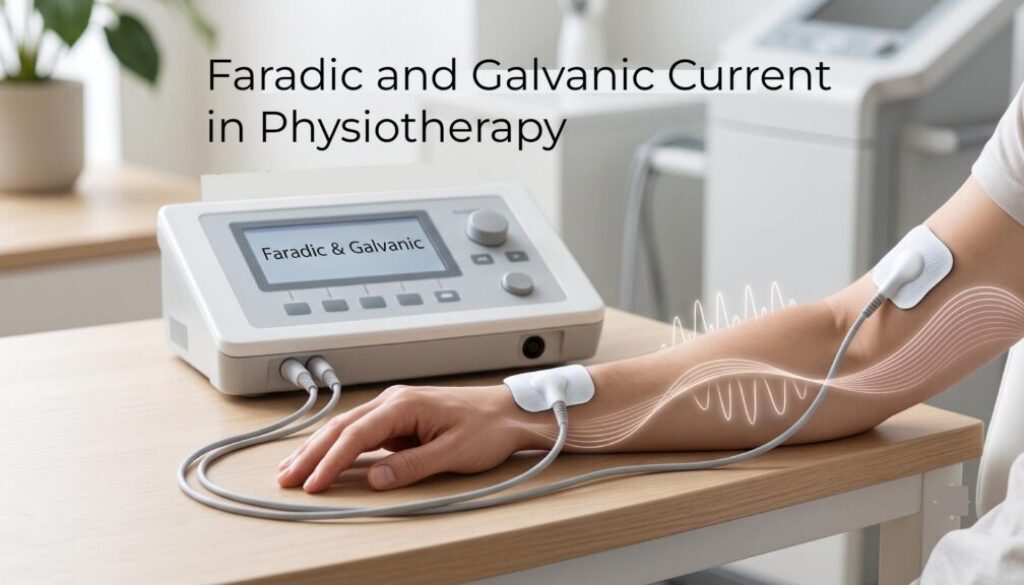
An electrical muscle stimulator, sometimes called an EMS or NMES device, generates and delivers these currents through electrodes placed on the skin over the affected muscle or nerve pathway. This creates a closed circuit through which the electrical impulse travels, triggering a physiological response in the underlying tissue.
If you want a broader look at how electrotherapy compares with other physical modalities, our detailed comparisons on ICT vs IPT vs IFT in physiotherapy and IRR vs laser vs electrotherapy explain where faradic and galvanic current fit into the wider toolkit.
What Is Faradic Current?
Faradic current is an interrupted direct current, essentially a rapid series of short electrical pulses rather than a continuous flow. It is named after Michael Faraday, whose work on electromagnetism laid the foundation for how these currents are generated and applied.
Key waveform characteristics of faradic current include:
- Pulse duration: 0.1 to 1 millisecond
- Frequency: 50 to 100 Hz
- Waveform: Rapid rise, near-instant fall (spike-shaped pulse)
- Ion transfer: Minimal to none, so there is no significant chemical effect on the skin
Because the pulse duration is so short, faradic current only stimulates muscles that still have an intact nerve supply, referred to as innervated muscles. When applied over a muscle or its motor point, it triggers depolarization of the motor nerve fibers, which in turn produces a visible muscle contraction. This is the basis of most electrical muscle stimulation used for strengthening and re-education in physiotherapy today.
What Is Galvanic Current?
Galvanic current is a continuous, uninterrupted direct current named after the Italian physician Luigi Galvani, who first documented the relationship between electricity and muscle contraction. Unlike faradic current, galvanic current flows steadily in one direction rather than pulsing on and off rapidly.
Key characteristics of galvanic current include:
- Flow type: Continuous direct current (or long-duration interrupted direct current when modified)
- Pulse duration (when interrupted): Often 100 milliseconds or longer, sometimes extended to 300 to 600 milliseconds
- Frequency: Roughly 30 pulses per minute in its interrupted form
- Ion transfer: Significant, causing a genuine chemical and electrolytic effect at the electrode sites
Because galvanic current uses long, sustained pulses, it can directly depolarize muscle fibers even when the nerve supply has been damaged. This is what makes it clinically useful for denervated muscle, a category of tissue that faradic current cannot effectively stimulate.
Therapeutic Effects of Faradic Current in Physiotherapy
This is where faradic current earns its place in almost every physiotherapy clinic and home rehabilitation program. The therapeutic effects of faradic current are wide-ranging, and they are backed by decades of clinical use in orthopedic, neurological, and sports rehabilitation settings.
1. Muscle Re-Education
After surgery, prolonged immobilization, or a joint injury, the brain sometimes struggles to recruit a muscle correctly even after healing is complete, a phenomenon known as arthrogenic muscle inhibition. Faradic current stimulates the motor nerve directly, producing a visible, involuntary contraction that helps “remind” the neuromuscular system how that muscle should fire. This is especially useful for the quadriceps after knee surgery or the shoulder stabilizers after a rotator cuff repair.
2. Prevention of Disuse Atrophy
When a limb is immobilized in a cast or sling, muscle mass can decline rapidly, sometimes within the first week. Faradic current keeps the muscle contracting during this period, which slows the rate of atrophy and preserves strength that would otherwise be lost while natural movement is restricted.
3. Muscle Strengthening
Because faradic current can produce a strong, near-tetanic contraction, it is used as an adjunct to voluntary exercise for strengthening weak but innervated muscles. It is particularly helpful for patients who cannot yet generate enough voluntary effort to strengthen a muscle through active exercise alone.
4. Pain Modulation Through the Gate Control Mechanism
Faradic current, especially in its surged form, can help reduce pain by overloading sensory nerve fibers, which interferes with the transmission of pain signals to the brain. This mechanism is similar to the one used in TENS, though faradic current additionally produces a muscle contraction that TENS typically does not.
5. Improved Local Circulation
The rhythmic muscle contraction produced by faradic stimulation acts like a pump, encouraging venous and lymphatic return from the treated area. This can help reduce localized swelling and support faster tissue recovery after injury.
6. Reduction of Muscle Spasm
Surged faradic current, where the intensity rises and falls gradually, is often used to ease muscle spasms, particularly in the lower back and neck, by promoting rhythmic contraction and relaxation cycles that fatigue overactive muscle fibers.
7. Functional Recovery After Neurological Events
In patients recovering from a stroke or other neurological injury with residual innervation, faradic-type stimulation (often applied through modern Neuromuscular Electrical Stimulation or Functional Electrical Stimulation devices) supports motor relearning and helps maintain joint mobility during the recovery window.
Therapeutic Effects of Galvanic Current
Galvanic current works through a fundamentally different mechanism, and its therapeutic effects reflect that.
1. Stimulation of Denervated Muscle
This is the defining therapeutic use of galvanic current. When a peripheral nerve is damaged, as seen in conditions like foot drop or facial palsy, the muscle it supplies loses its normal nerve signal. Galvanic current’s long pulse duration can directly depolarize the muscle fiber itself, producing a slow, worm-like contraction that keeps the muscle active and helps delay atrophy while the nerve regenerates.
2. Iontophoresis for Drug Delivery
Galvanic current can drive charged medication ions through the skin and into underlying tissue, a technique called iontophoresis. This is used to deliver anti-inflammatory or analgesic medication directly to a painful joint or tendon without needing an injection.
3. Pain Relief in Chronic Conditions
Galvanic current is often used for chronic pain conditions such as osteoarthritis, where its sustained, low-intensity stimulation helps modulate pain perception over a longer treatment window compared to faradic current.
4. Edema and Swelling Reduction
Placement of the cathode over a swollen area can encourage vasodilation, which supports lymphatic drainage and helps reduce localized edema, particularly useful in the early stages of soft tissue injury.
5. Support for Wound and Ulcer Healing
The electrolytic effect of galvanic current has been used to encourage cell migration and support the healing process in chronic skin ulcers and slow-healing wounds, in combination with standard wound care.
Faradic vs Galvanic Current: Key Differences
|
Parameter |
Faradic Current |
Galvanic Current |
|
Type of current |
Interrupted direct current (short duration) |
Continuous or long-duration interrupted direct current |
|
Pulse duration |
0.1 to 1 millisecond |
100 milliseconds or longer |
|
Frequency |
50 to 100 Hz |
Around 30 pulses per minute (interrupted form) |
|
Works on denervated muscle |
No |
Yes |
|
Chemical/ion effect |
Minimal |
Significant |
|
Primary use |
Muscle re-education, strengthening, muscle spasm relief |
Denervated muscle stimulation, iontophoresis, chronic pain, edema |
|
Typical session length |
10 to 15 minutes |
15 to 30 minutes |
|
Common target muscles |
Larger muscle groups such as the quadriceps and deltoid |
Smaller muscles, facial muscles, denervated limb muscles |
Clinical Indications: When Physiotherapists Use Each Current
Faradic current is commonly indicated for:
- Disuse atrophy following cast immobilization or prolonged bed rest
- Post-surgical muscle weakness, such as after ACL reconstruction or joint replacement
- Muscle re-education following orthopaedic conditions and soft tissue injuries
- Sports-related muscle strains where rapid restoration of strength is needed
- Functional paralysis where nerve supply remains intact
Galvanic current is commonly indicated for:
- Denervated muscle conditions, including radial nerve palsy presenting as wrist drop
- Facial nerve palsy (Bell’s palsy) and trigeminal neuralgia
- Chronic pain management in conditions such as osteoarthritis and lumbar spondylosis
- Iontophoresis-based drug delivery for localized inflammation
- Early-stage edema management after soft tissue trauma
For patients recovering from peripheral nerve injuries specifically, our detailed guide on physiotherapy for wrist drop explains how electrotherapy fits into a complete recovery protocol alongside splinting, manual therapy, and staged exercises.
Contraindications and Safety Precautions
Both currents are generally safe when applied by a trained physiotherapist, but there are situations where caution or complete avoidance is necessary:
- Cardiac pacemakers or implanted electronic devices: Electrical currents can interfere with device function.
- Pregnancy: Avoid application over the abdomen and lower back.
- Open wounds, active infection, or skin conditions at the electrode site.
- Malignancy in or near the treatment area.
- Metal implants directly under the electrode placement site, which require adjusted parameters.
- Thrombosis or active bleeding disorders.
- Impaired sensation, since patients may not be able to accurately report excessive intensity, increasing the risk of skin irritation or burns.
Mild skin redness or a tingling sensation is normal and expected. However, overuse of galvanic current, particularly at high intensity or for extended durations, can cause chemical burns due to sustained ion transfer at the electrode site. This is why treatment parameters, electrode placement, and session duration should always be determined and monitored by a qualified physiotherapist rather than self-administered with consumer-grade devices.
How Physiotherapists Decide Between Faradic and Galvanic Current
One question patients rarely find answered clearly online is how a physiotherapist actually chooses between the two. The decision typically comes down to a simple clinical question: is the nerve supply to the muscle intact or interrupted?
- Assess nerve integrity first. A physiotherapist evaluates whether the muscle is innervated or denervated, often supported by findings from nerve conduction studies or electromyography if a neurological cause is suspected.
- Match the current to the tissue response needed. If the muscle responds to short-duration pulses with a brisk contraction, faradic current is appropriate. If it only responds to long-duration pulses, galvanic current becomes necessary.
- Factor in the treatment goal. Strengthening and re-education favor faradic current. Pain relief, drug delivery, or denervated tissue support favor galvanic current.
- Consider the stage of recovery. In the early post-injury phase, galvanic current may be used for pain and swelling, transitioning to faradic current as active muscle recruitment becomes the priority.
- Reassess regularly. As a denervated muscle begins reinnervation, the physiotherapist may gradually shift from galvanic to faradic stimulation to match the tissue’s changing response.
This decision-making process is exactly why electrotherapy should be administered as part of a supervised physiotherapy plan rather than applied independently at home with generic stimulation devices.
Can Faradic and Galvanic Current Be Combined?
Yes, and in many real-world treatment plans, they are. For example, a patient recovering from partial nerve damage with some muscle strength intact may receive galvanic current to support the weaker, partially denervated fibers, while faradic current is used simultaneously or in the same session to strengthen the muscle groups that still have full nerve supply. The two currents complement rather than compete with each other, provided the treatment parameters are carefully individualized to avoid overstimulation or fatigue.
The Role of Supervised, Home-Based Electrotherapy
Electrotherapy is often more effective when it is part of a broader, personalized rehabilitation plan rather than a standalone treatment. This is particularly true for conditions involving nerve injury or post-surgical recovery, where progress needs to be tracked closely and treatment parameters adjusted as the tissue responds.
At Physio at Your Doorstep, our physiotherapists bring clinical-grade electrotherapy equipment and expertise directly to your home across Bangalore, so you receive properly monitored faradic or galvanic current treatment alongside manual therapy and a progressive exercise program. This is especially valuable for patients under our neurological physiotherapy, orthopaedic physiotherapy, and post-surgical physiotherapy programs, where consistent, supervised electrical stimulation forms one part of a larger recovery strategy. If travel is difficult, our online physiotherapy consultation service can also help guide your overall rehabilitation plan remotely.
What Does Research Say?
Clinical literature on low-frequency currents generally supports their role as an adjunct rather than a standalone cure. Studies on electrical muscle stimulation report measurable improvements in muscle strength and reduced disuse atrophy when faradic-type stimulation is combined with active exercise, particularly in post-surgical and immobilized populations. Similarly, galvanic current’s role in stimulating denervated muscle has long been documented in physiotherapy education and rehabilitation texts, though most contemporary guidelines emphasize that outcomes are best when electrotherapy is paired with manual therapy, splinting where needed, and a structured, progressive exercise program rather than used in isolation. This combined-modality approach is consistently reflected in evidence-based practice guidelines for nerve palsy, post-operative rehabilitation, and chronic musculoskeletal pain management.
Resources and Further Reading
- Physiopedia – Faradic Stimulation: https://www.physio-pedia.com/Faradic_Stimulation
- Neurological Physiotherapy Services at Physio at Your Doorstep: https://physioatyourdoorstep.com/service/neurological-physiotherapy/
- Orthopaedic Physiotherapy at Physio at Your Doorstep: https://physioatyourdoorstep.com/service/orthopaedic-physiotherapy/
- Physiotherapy for Wrist Drop, Radial Nerve Care Guide: https://physioatyourdoorstep.com/physiotherapy-for-wrist-drop/
- ICT vs IPT vs IFT in Physiotherapy: https://physioatyourdoorstep.com/ict-vs-ipt-vs-ift-in-physiotherapy/
Ready to experience professionally supervised electrotherapy and physiotherapy at home? Our qualified physiotherapists at Physio at Your Doorstep bring evidence-based faradic and galvanic current treatment, along with complete rehabilitation programs, directly to your doorstep across Bangalore. Call us at +91 82337 87737 or book an appointment online today.